
Author: Dr Ramamoorthy Ayyamperumal
Journal: Journal of Hazardous Materials Advances– Elsevier (Impact Factor-7.7)
Urban rivers once pristine ecosystems are now bearing the burden of rapid industrialization and urban sprawl. Our recent study sheds light on an alarming issue hiding beneath the flowing waters of two major urban rivers: the Adyar and Cooum rivers. These water bodies in India have been heavily affected by trace elemental contamination, a silent but potent threat to environmental and human health. As Chennai rapidly transforms into a major metropolitan hub, its rivers—Adyar and Cooum—are silently suffering under the weight of unchecked industrial growth and urban expansion. In a recent study, we investigated the alarming levels of heavy metal contamination in the sediments of these rivers, uncovering ecological risks that demand immediate attention.
Our Study: Digging Into the Sediments
We conducted an extensive investigation to assess the contamination levels, sources, and spatial distribution of eight key heavy metals in the riverbed sediments of Adyar and Cooum. The rivers traverse diverse urban zones, residential areas, industrial estates, commercial zones, and green spaces each contributing unique pollutant signatures.
Key Highlights:
Environmental and Human Health Risks: The contamination is not just a local concern. These trace elements can infiltrate groundwater or be remobilized into the water column, affecting drinking water sources, fisheries, and agriculture.
High Contamination Levels: Elevated concentrations of Pb, Cd, and Cr were found, particularly near industrial discharge points and areas with heavy traffic.
Source Identification: Statistical tools such as Principal Component Analysis (PCA) helped distinguish pollution sources. Industrial effluents, untreated sewage, vehicular emissions, and improper waste disposal were identified as the major contributors.
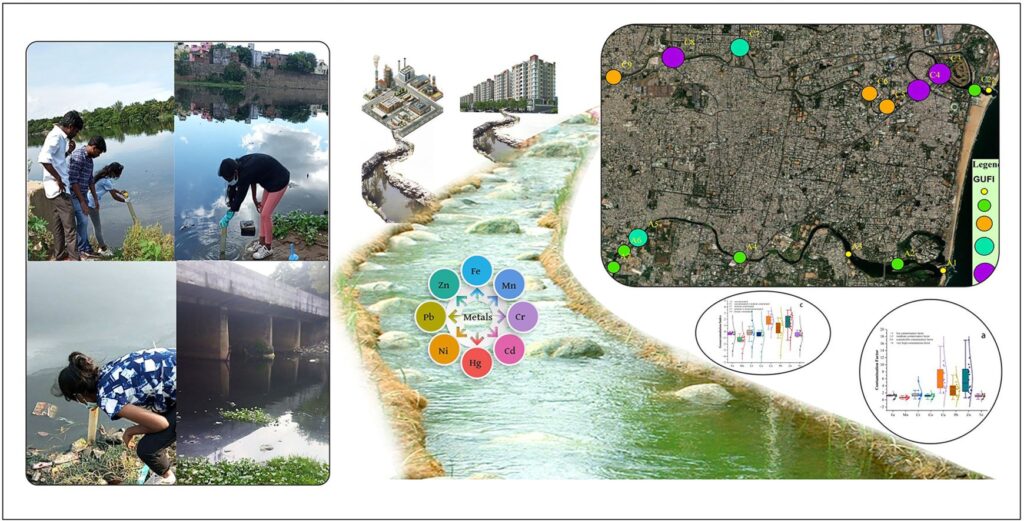
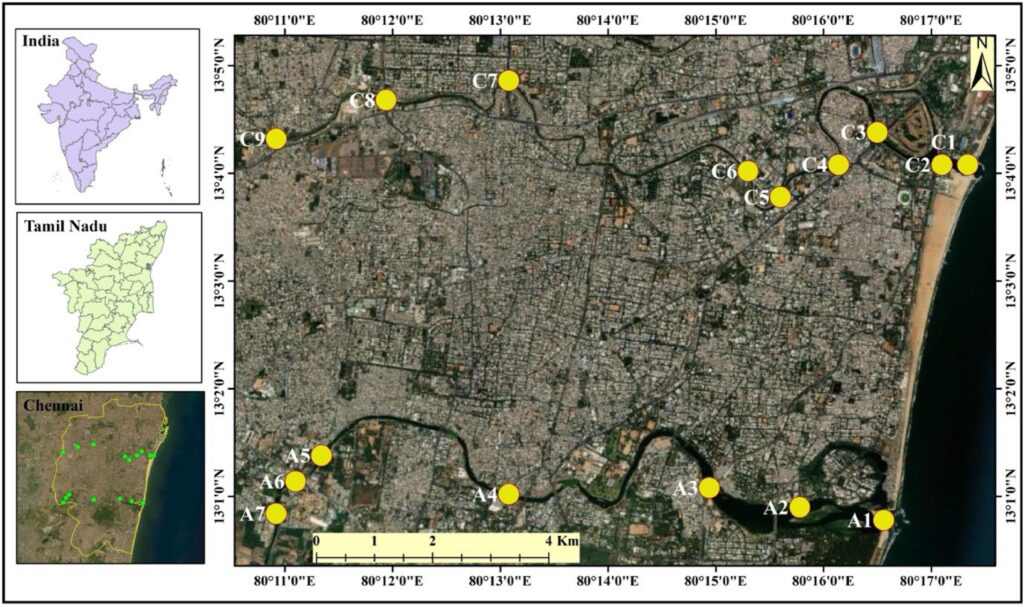
In this study, highlights the significant contamination of heavy metals in the Adyar and Cooum rivers, primarily driven by rapid industrialization, urban expansion, and inadequate wastewater management. A total of 16 sediment samples were collected and analyzed to determine the spatial distribution, sources, and ecological risks associated with heavy metal contamination in these rivers. The contamination factor (CF) and geo-accumulation index (Igeo) revealed that the majority of sediment samples are moderately to highly polluted with Cr (162 ppm), Zn (400 ppm), Mn (480 ppm), and Cd. The pollution load index (PLI) values above 1, indicating that sediment quality is deteriorating. Furthermore, spatial research found that the north-eastern regions pose higher ecological risk than the northwest. Significant correlations (r > 0.85, p < 0.05) were found between Fe and Cr, Cu, Zn, and Pb, indicating a common anthropogenic source. The mean concentration of heavy metals (ppm) of sediments are as follows: Fe (38,456), Mn (480), Cr (162), Cu (172), Pb (51), Zn (400), Ni (49), and Co (22). The enrichment factor (EF) values ranged from 0.1 to 18.9, with Cu (EF = 5.2) and Zn (EF = 4.8) showing significant anthropogenic enrichment. The contamination factor (CF) ranged from 0.09 to 16.95, categorizing the sediments as moderately to severely contaminated. The potential ecological risk index (PERI) ranged from 16.58 to 127.48, with the highest risk observed in industrial zones. The modified hazard quotient (mHQ) identified Cu > Cr > Ni > Zn > Pb as the primary contaminants, while the toxic risk index (TRI) averaged 12.5 (range: 2.6–24.3), highlighting notable ecological concerns. Our research findings indicate that rapid urbanization, industrial effluents, and untreated sewage are key contributors to sediment contamination. This study underscores the need for sustainable pollution management strategies to mitigate heavy metal accumulation in riverine sediments.
Our Research findings, it is clear that a comprehensive and sustainable river management strategy is essential. Such a strategy should include long-term monitoring programs, stringent pollution control measures, and public awareness campaigns to minimize the discharge of heavy metals into the rivers. Furthermore, integrating watershed management approaches, green infrastructure, and enforcing stricter industrial regulations will be crucial in addressing the ongoing pollution crisis. By implementing these strategies, policymakers, industries, and local communities can collaborate to restore the ecological health of the Adyar and Cooum rivers, ultimately safeguarding both aquatic ecosystems and public health.
Let’s not wait for a crisis to recognize the silent threats beneath our rivers. Clean rivers are not just an environmental necessity—they are a human right.